Planet-sized telescope gives a sharp view into black
holes
The South
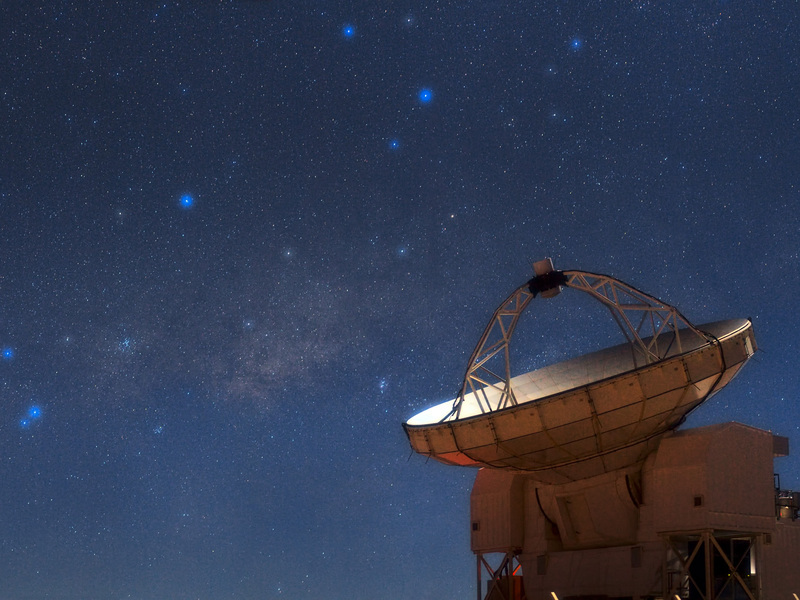
Pole Telescope (SPT) and the Atacama Pathfinder Experiment (APEX) joined
together in a “Very Long Baseline Interferometry” experiment for the first time
in January 2015. The two telescopes together observed two sources — the black
hole at the centre of the Milky Way galaxy, Sagittarius A*, and the black hole
at the centre of the nearby galaxy Centaurus A — and combined their signals to
synthesize a telescope 7,000 kilometres across (yellow line). With this
success, the SPT joins the Event Horizon Telescope array, which connects APEX,
the Large Millimeter Telescope in Mexico, the Submillimeter Telescope in
Arizona, the Combined Array for Research in Millimeter-wave Astronomy in California,
the Submillimeter Array and James Clerk Maxwell Telescope in Hawaii, and the
Institute for Radio Astronomy Millimetrique (IRAM) telescopes in Spain and
France (not visible). Image credit: Dan Marrone/University of Arizona
Astronomers
building an Earth-size virtual telescope capable of photographing the event
horizon of the black hole at the centre of our Milky Way have extended their
instrument to the bottom of the Earth the South Pole — thanks to recent
efforts by a team of astronomers with participation of the Max Planck Institute
for Radio Astronomy (MPIfR) in Bonn, Germany.
Last
December, an international team of astronomers flew to the Southern Hemisphere:
German, Chilean and Korean scientists led by Alan Roy of the MPIfR, traveled to
Atacama, Chile, and American scientists led by Dan Marrone of the University of
Arizona flew to the South Pole to arrange the telescopes into the largest
virtual telescope ever built — the Event Horizon Telescope, or EHT. By
combining telescopes across the Earth, the EHT will take the first detailed
pictures of black holes.
“The
goals of the EHT are to test Einstein’s theory of general relativity,
understand how black holes eat and generate relativistic outflows, and to prove
the existence of the event horizon, or ‘edge,’ of a black hole,” says Dan
Marrone.
APEX,
which recorded successful joint observations with the Atacama Large Millimeter
Array (ALMA) on 13th January 2015, with a virtual telescope of 2.08 kilometres
in size, has now been connected with the SPT, more than 7,000 kilometres away.
This is the latest addition to an array of telescopes spread out across the
globe and linked using a technique known as very long baseline interferometry,
or VLBI. Larger telescopes can make sharper observations, and interferometry
allows multiple telescopes to act like a single telescope as large as the
separation — or “baseline” — between them. Using VLBI, the sharpest
observations can be achieved by making the separation between telescopes as
large as possible.
“To make
this work we had to bring cutting edge technology to some of the most remote
places on Earth,” says Alan Roy. “It is a logistic challenge to include an
increasing number of telescopes from Hawaii to Europe, from North America to
Chile and to the South Pole to provide us with muchimproved image quality and
sharpness.”
Even
though the Milky Way’s black hole, known as Sagittarius A* (pronounced
‘A-star’), is 4 million times more massive than the Sun, it is tiny to the eyes
of astronomers. Smaller than Mercury’s orbit around the Sun, yet almost 26,000
light-years away, studying its event horizon in detail is equivalent to
standing in New York and reading the date on a cent in Germany.
With its
unprecedented resolution, more than 1,000 times better than the Hubble
telescope, the EHT will see swirling gas on its final plunge over the event
horizon, never to regain contact with the rest of the universe. If the general
theory of relativity is correct, the black hole itself will be invisible
because not even light can escape its immense gravity. However, it might still
be seen as a silhouette against the background.
First
postulated by Albert Einstein’s general theory of relativity, the existence of
black holes has since been supported by decades’ worth of astronomical observations.
Most if not all galaxies are now believed to harbour a supermassive black hole
at their centre, and smaller ones formed from dying stars should be scattered
among their stars. The Milky Way is known to be home to about 25 smallish black
holes ranging from five to 10 times the Sun’s mass. But never has it been
possible to directly observe and image one of these cosmic oddities.
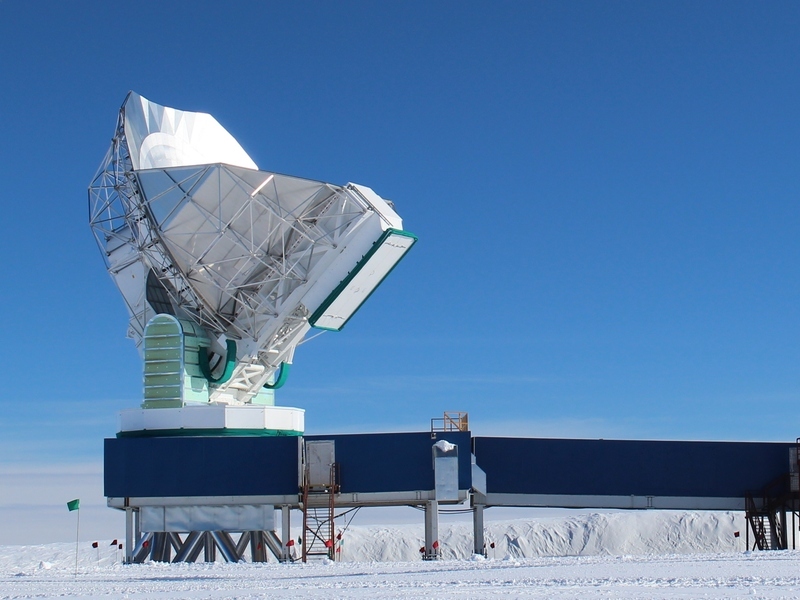
The 10-metre South Pole Telescope, at the National Science
Foundation’s Amundsen-Scott South Pole Station, joined the global Event Horizon
Telescope array in January 2015. Image credit: Dan Marrone/University of
Arizona
For their
preliminary observations, the joint telescopes pointed to two known black
holes, Sagittarius A* in our galaxy, and another, located 10 million
light-years away in a galaxy named Centaurus A. For this experiment, the APEX
telescope in Chile and the SPT in Antarctica observed together, despite being
nearly 7,000 km apart. Their detections are the highest-resolution observations
ever made of either object in the southern sky, beating the previous record of
peering into the heart of an active galactic nucleus by a factor of 10.
Detecting a compact feature in Centaurus A at the resolution of 50
microarcseconds is equivalent to measuring an object of 150 times the
gravitational radius of the black hole at its centre, believed to have a mass
of 70 million solar masses.
“Centaurus
A is not visible from central Europe and it has always been on our wish list,”
says Alan Roy who knows the source quite well from Australia where he grew up.
“And it is very impressive to detect Sagittarius A*, the central source of our
Milky Way, at such high resolution.”
The
addition of the SPT enhances the annual EHT experiments that combine telescopes
all over the world. Several new telescopes have been preparing to join the EHT
in the next year, meaning that the next experiment will be the largest both
geographically and with regard to the number of telescopes involved. The
engagement of the MPIfR is present through APEX and the IRAM telescopes in Pico
Veleta (Spain) and Plateau de Bure (France), all operating at a wavelength as
short as 1.3 mm.
http://astronomynow.com/2015/04/21/planet-sized-telescope-gives-a-sharp-view-into-black-holes/
No comments:
Post a Comment